Tiếng Việt
 日本語
日本語
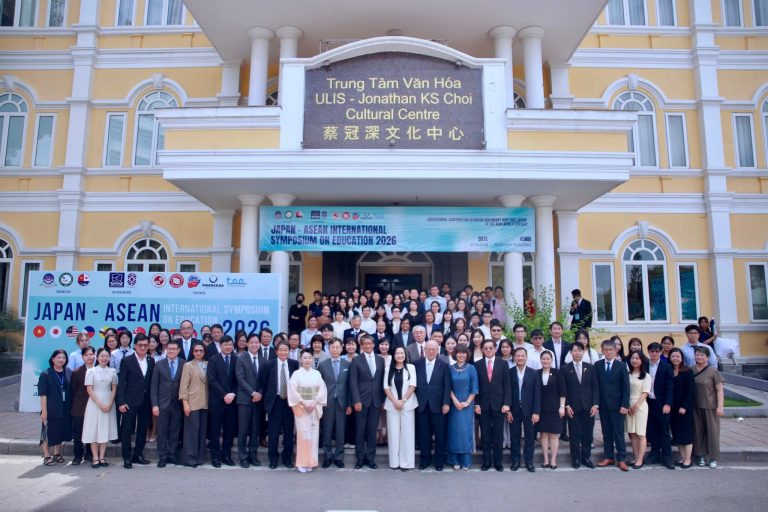
On June 25, 2026, at the VNU University of Languages and International Studies, the Vietnamese Alumni of Japan (VAJA), in coordination with the ASEAN Council of Japan Alumni (ASCOJA) and ASJA International, successfully hosted the 4th Japan - ASEAN International Symposium on Education (JASE 2026 or JASE 4). The JASE 4 symposium was co-organized by the VNU University of Languages and International Studies and the Center for Language, Education and Culture Development Research (CLEF), with the collaboration of Vietnam-Japan University, Foreign Trade University, Phenikaa University, and The TOA Institution (East Asia Research Institute).
This event holds tremendous significance, being the first major event since the 28th ASCOJA Conference held in Thailand in October 2025. It is also one of the specialized symposiums of ASCOJA member associations based on VAJA's initiative, cyclically hosted by VAJA since the first time (JASE 1) in 2015, the second time (January 2018), and the third time (June 2022). This is also an important milestone in the activities celebrating the 25th anniversary of VAJA's establishment (2001 - 2026). Regarding ASCOJA's general activities, this symposium is a practical continuation of the strategy proposed by the 28th ASCOJA Conference: "Strengthening ASEAN - Japan human resources through Human Resource Development and quality enhancement." Therefore, under VAJA's chairmanship and with the attention of numerous leaders from related organizations in Japan and ASEAN countries, the reports presented at the Symposium were extremely rich and profound. They reflected a deep concern for the "Human" factor and ASEAN-Japan cooperation, aiming to elevate intercultural activities and the ability of the ASEAN - Japan younger generation to work in a global environment within the new, developing, and volatile context of the world today.

The JASE 4 symposium was held over one day with the general theme "Educational Cooperation between ASEAN and Japan in the new world context." The presentations included 2 keynote reports delivered at the plenary session, and 18 reports presented in the afternoon, divided into 3 sub-committees: 1) Human resources and human resources education cooperation; 2) Language and cultural exchange activities - a foundation of cooperation between Southeast Asia and Japan; and 3) Foreign language education policies in the new world context. Over the past 10 years, through 3 editions of the Japan and ASEAN international education symposium, the event has attracted growing and profound interest not only from ASCOJA members but also from numerous Japanese and Vietnamese organizations and agencies. Consequently, for this edition, the JASE 4 Organizing Committee received more than 30 submissions, from which 2 keynote reports were selected for the plenary session and 18 reports were chosen for presentation in the sub-committees.

Delegates and guests at the Symposium
The symposium was honored to receive the attention and attendance of distinguished delegates. From Japan, the Symposium was privileged to welcome H.E. Mr. Ito Naoki - Ambassador Extraordinary and Plenipotentiary of Japan to Vietnam, Mr. Takebe Tsutomu - Special Advisor to the Japan - Vietnam Friendship Parliamentary Alliance, Mr. Hikihara Takeshi - Board Member of ASJA International and former Japanese Ambassador to Laos, Mr. Matsuoka Kazuhisa - Secretary General of ASJA International, Ms. Hagihara Chikako - Chief of the ASJA International Secretariat, Mr. Yamazaki Hiroki - Executive Director of the Toshiba International Foundation, Mr. Tomita Sho - Chairman and CEO of The TOA Institution, along with representatives from many prestigious organizations such as the Japan Foundation, JICA, JETRO, JASSO, ANA, and various Japanese enterprises operating in Vietnam.
From Southeast Asian countries, the Symposium welcomed delegates who are leaders and presenters from 10 alumni associations of Southeast Asian countries in Japan (including Indonesia, Philippines, Singapore, Malaysia, Myanmar, Brunei, Thailand, Laos, Cambodia, and Vietnam). Notably, the Vietnamese delegation of presenters delivered 8 out of the 18 reports at the symposium's specialized sub-committees.

Representatives from 9 Southeast Asian countries taking a commemorative photo with Ambassador Ito Naoki
From Vietnam, attendees included Mr. Nghiem Vu Khai - Former Deputy Minister of Science and Technology, Former Chairman of the Vietnam - Japan Friendship Association, and Honorary President of VAJA; Ms. Nguyen Thi Mai Huu - Head of the National Foreign Language Project, Ministry of Education and Training; Mr. Do Tuan Minh - President of the VNU University of Languages and International Studies; Mr. Nguyen Hoang Anh - Rector of Vietnam-Japan University; and Mr. Ngo Tu Lap - Director of the International Francophone Institute.
In addition to the invited guests and delegates, the Symposium also recorded the attendance of a large number of lecturers and students from the University of Languages and International Studies.
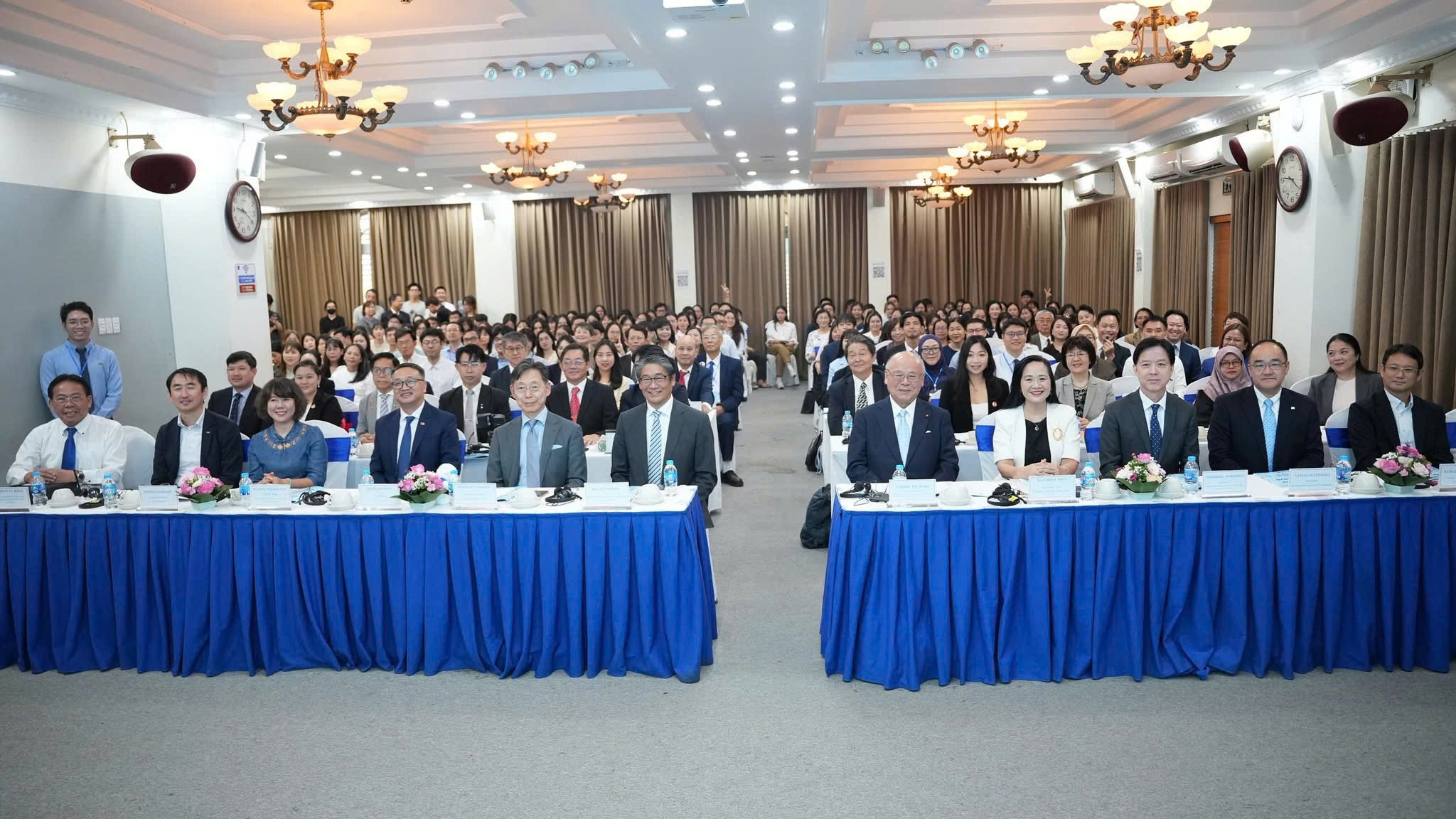
Delegates and guests attending the JASE 4 Symposium
At the plenary session held in the morning, following the opening remarks by President Ngo Minh Thuy and Mr. Do Tuan Minh - President of the University of Languages and International Studies, the Ambassador Extraordinary and Plenipotentiary of Japan to Vietnam, Mr. Ito Naoki, delivered a congratulatory speech. The Ambassador highly appreciated that "Over the past 10 years, the fact that educators and researchers from Japan and ASEAN gather in one place to exchange ideas and dialogue about the future of education is extremely meaningful and highly commendable." Citing the quote "Talent is the nation's vitality" engraved at the Temple of Literature, the Ambassador clearly pointed out that "training and developing human resources is an extremely important task not only for Vietnam but also for Japan and ASEAN countries...". After reviewing the role of the Vietnam-Japan University, the Ambassador expressed his hope that this university would contribute to becoming a center for training, research, and intellectual exchange for the entire ASEAN region. The Ambassador hoped that through sharing knowledge, experiences, and professional perspectives of the attending delegates, new cooperative opportunities would emerge, and at the same time, the educational and academic linkage between Japan and ASEAN would continue to be further strengthened in depth.

VAJA President - Assoc. Prof. Dr. Ngo Minh Thuy delivering the opening remarks

Mr. Do Tuan Minh delivering the opening remarks

Ambassador Ito Naoki delivering the opening remarks

Mr. Hikihara Takeshi delivering the opening remarks
Opening the main content of the plenary session was the keynote report titled "Nation building starts with human building: How the Hexagonal Society and the Practical Japanese Studies Test (Nippon-Gaku) will open a new era for Japan, Vietnam, and ASEAN" by Mr. Takebe Tsutomu, Special Advisor to the Japan - Vietnam Friendship Parliamentary Alliance. He is a politician who has been very closely associated with Japan-Vietnam cooperation programs as well as activities supporting foreign human resources in Japan. He was a pioneer in advocating for the establishment and development of the Vietnam-Japan University, stating it is "not simply 'opening another university', but 'The mission of the school is to transmit to the younger generation of Vietnam the traditions of wisdom, technology, manufacturing culture, and Japanese social structure - to cultivate a new type of university, nurturing human bridges between the two nations'." At the same time, it is to "train human resources ready to work in the fields of Information Technology, Artificial Intelligence, Japanese language, and business - people who can combine theory and practice, solving real-world problems"... The cultivation of human resources in today's world is shifting from a "pyramid" structure model to a "hexagonal society" model, along with labor mobility requiring education through the Practical Japanese Studies Test (Nippon-Gaku). All these requirements "are bound together by a single thread: 'human building'", and "investing not only in physical infrastructure but also in software - in people and institutions...". In particular, Mr. Takebe Tsutomu pointed out the "gap on the Japanese side" in the path of building from the goods supply chain with ASEAN countries over the past decades to the "ASEAN talent circulation with the 'Human Resource Supply Chain' and the Practical Japanese Studies Test (Nippon-Gaku)". In this, there must be a greater focus on the profound understanding truly necessary to live and work in Japan - the rules of daily life, practicing workplace rules and discipline, and better understanding the "Japanese spirit". These are "practical Japanese studies knowledge, which goes beyond vocabulary and grammar, including national spirit, values, norms, understanding implicit conventions, the culture of 'reading the room', and the practice of Japan's Ho-Ren-So". That is practical, integrated understanding that helps foreigners behave calmly like members of Japanese society, something the educational system for foreigners working in Japan has not fully met until now. The addition of the Nippon-Gaku educational model and test will create "an invisible infrastructure for harmonious coexistence between Japan and foreigners who can live, work, and study in Japan."
After expressing basic and systematic views on the strategy of human building in the new context of the world, Mr. Takebe Tsutomu highlighted his desire to implement these strategies "Starting from Vietnam, expanding throughout ASEAN, and reaching out to the world." The Nippon-Gaku educational model will start with the "Vietnam Model" - in other words, a form of Nippon-Gaku of the Vietnamese people, implemented by the Vietnamese people, and for the Vietnamese people. In close cooperation with the Vietnam-Japan University, including conducting pilot exams there, we will design and operate Nippon-Gaku in a way that suits Vietnam's educational culture. Based on that experience, we will develop the Indonesia model, the Philippines model, and country-specific versions within ASEAN, tailored to the language, culture, and industrial structure of each nation, with the ultimate goal of establishing an "ASEAN Standard". The soul of that educational strategy, as Mr. Takebe Tsutomu pointed out, is "It is precisely through cultural exchange that new culture is born, new technology and new growth are generated." He expressed a deep desire that "the people present here - who understand both their home culture and Japanese culture from the inside - are the partners with whose deep understanding and cooperation, along with your creative ingenuity, Nippon-Gaku will develop into the ASEAN Standard." With the belief throughout his life of activities that "nation building starts with human building", and "it is the trust between people that truly sustains the relationship between nations", Mr. Takebe Tsutomu pointed out, "In this new global context, ASEAN is rising to the center of the world. Under the framework of the 'Evolved Free and Open Indo-Pacific' (Evolved FOIP), Japan and ASEAN must aim for an era where influence is not only based on hard power like production capacity and military strength, but also on soft power - wisdom, culture, character, and the power of information - and furthermore, towards a relationship where we share not only dry and calculating matters, but also warm, humanistic trust."
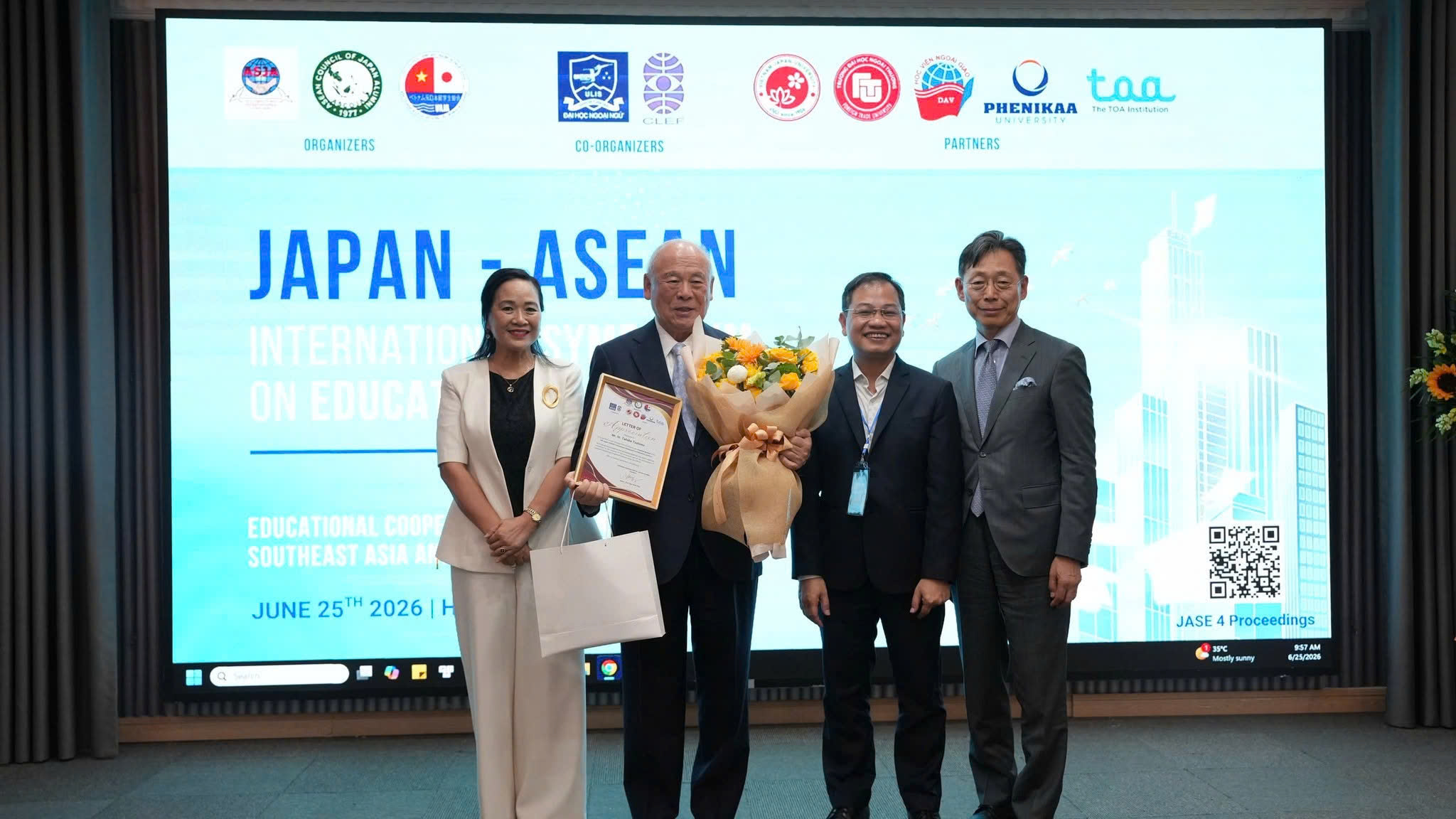
Mr. Takebe Tsutomu receiving flowers and a Letter of Appreciation from the Organizing Committee
The plenary session continued with the report "Foreign language education in Vietnam: current practices and future prospects," presented by Dr. Nguyen Thi Mai Huu, Head of the National Foreign Language Project Management Board, Ministry of Education and Training. In this report, she clarified the guidelines in major policies such as the National Foreign Language Project on strengthening the teaching and learning of foreign languages, gradually making English a second language in schools, and promoting the teaching of neighboring countries' languages, while digital technology is creating new opportunities for innovation in teaching and learning practices. Therefore, learners need to develop the ability to use multiple languages, from their mother tongue and national language to at least one foreign language, in order to access global knowledge, promote intercultural communication, and participate effectively in advanced science and the global economy, through effective policies in teaching, learning, and practicing foreign languages.
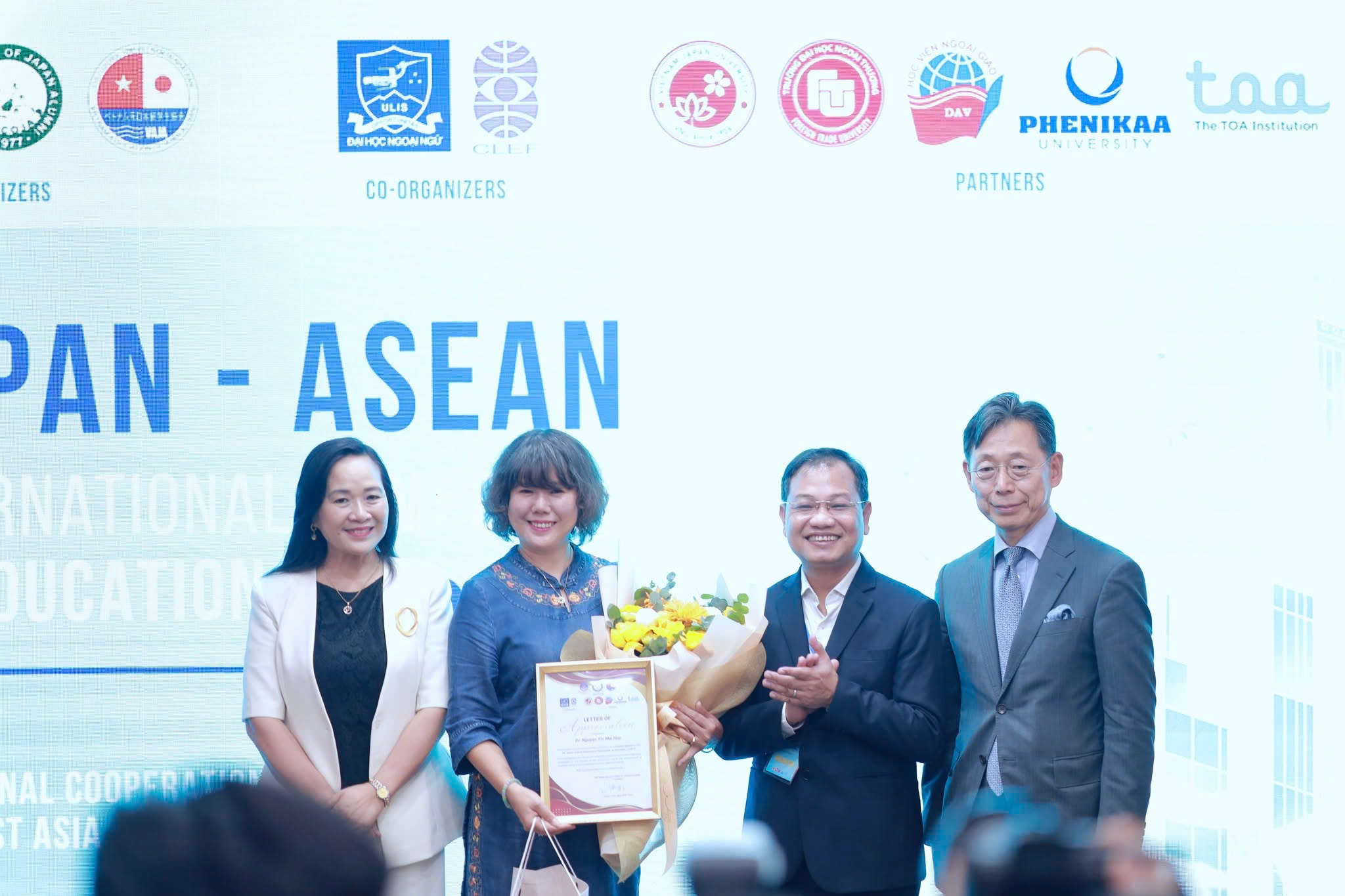
Dr. Nguyen Thi Mai Huu receiving flowers and a Letter of Appreciation from the Organizing Committee
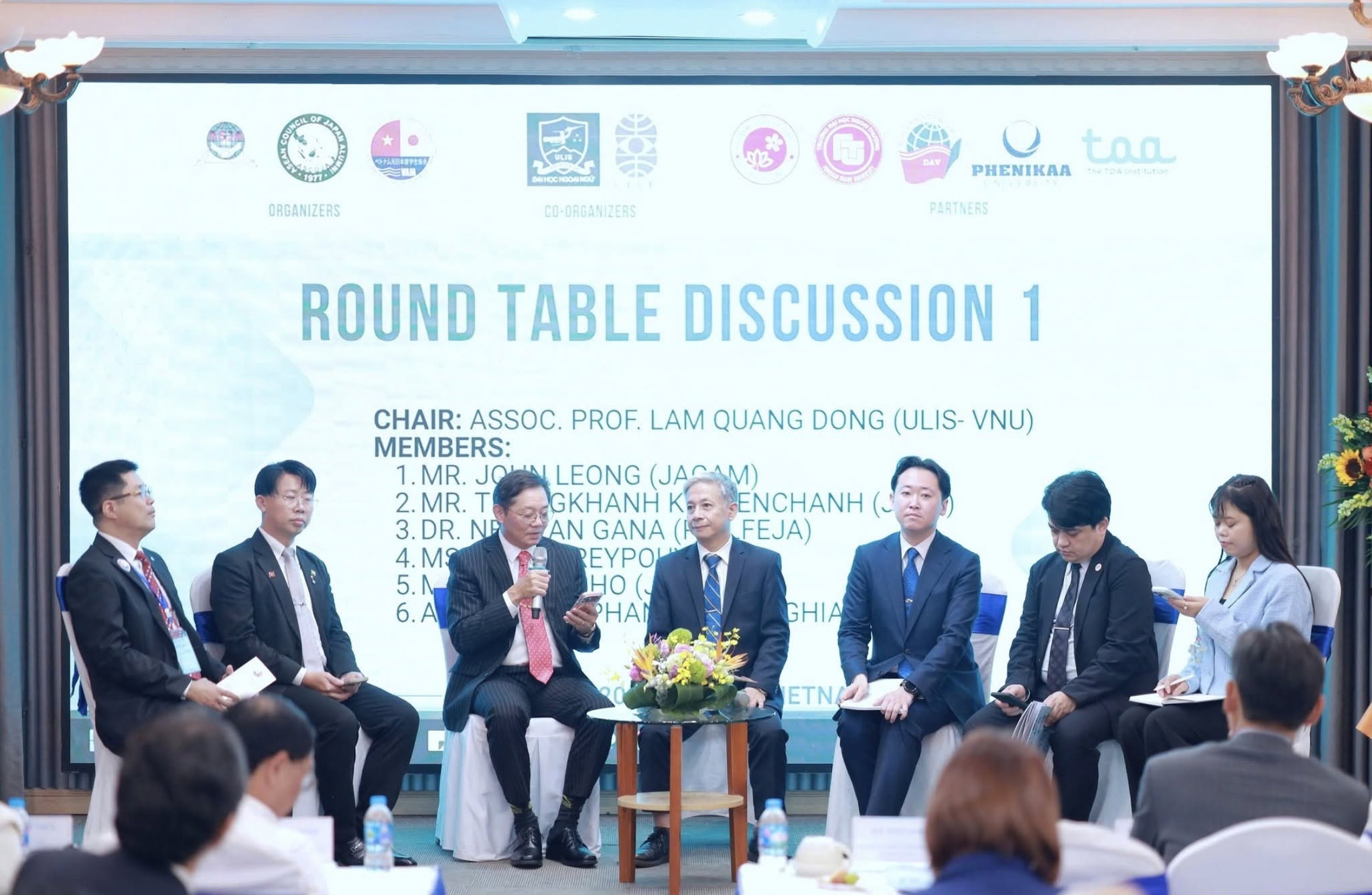
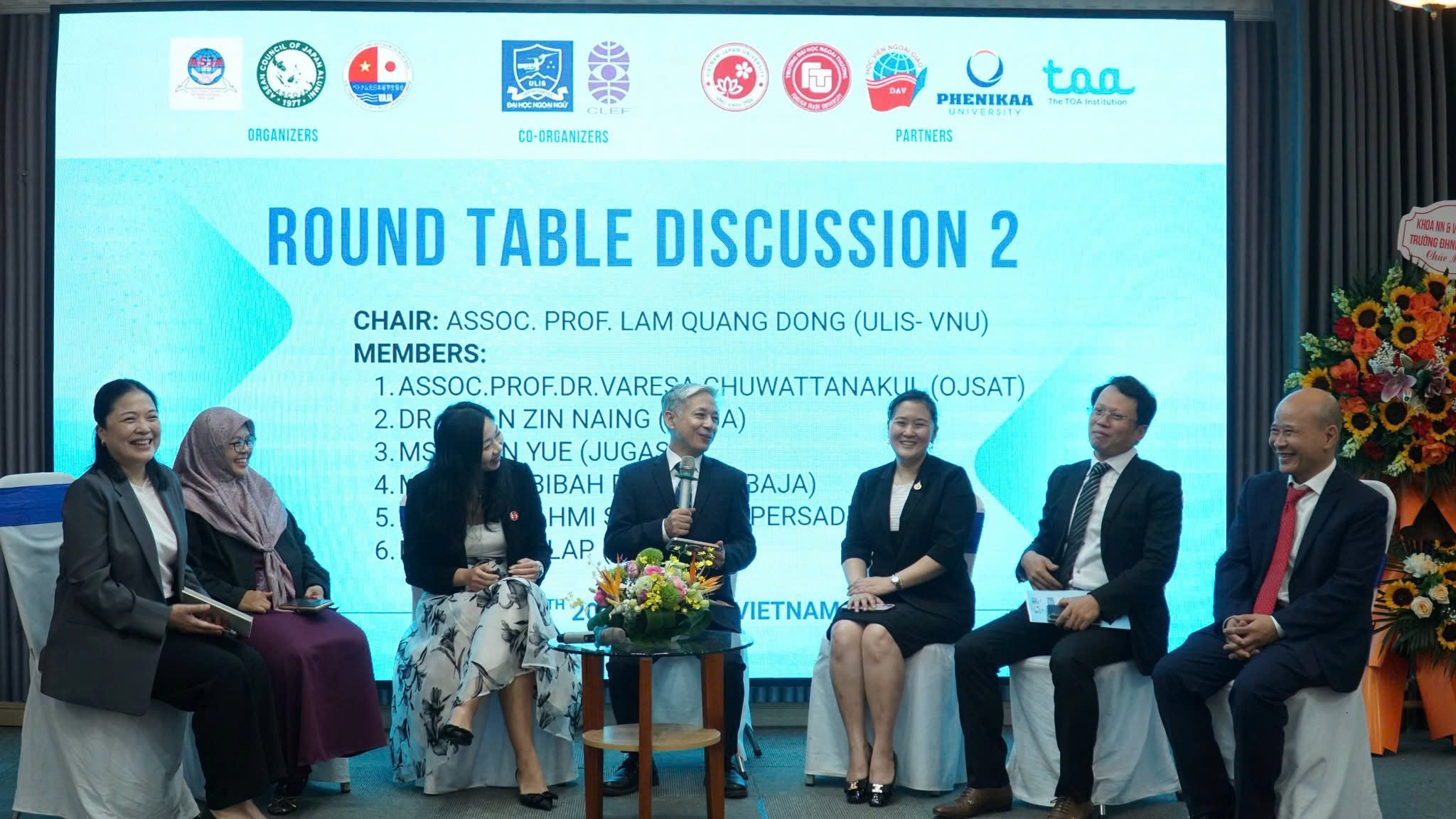
Following the 2 keynote reports mentioned above were 2 roundtable discussions with 2 topics: 1) Human resources and human resource cooperation between Japan and ASEAN, and 2) Culture - Language in Japan - ASEAN and cooperation between Japan - ASEAN. Chaired by Assoc. Prof. Dr. Lam Quang Dong - VNU University of Languages and International Studies, representatives of Japan and Southeast Asian countries participated actively in the 2 roundtable sessions, suggesting many issues in general cooperation and educational cooperation in particular.
In the afternoon, the Symposium was conducted in the form of 3 parallel sub-committees. At Sub-committee 1: "Human resources and human resources education cooperation," it opened with the report "Building future-ready human resources beyond technical skills in the ASEAN - Japan educational partnership" by Dr. Lavi Peñaverde - President and Director of Learning Support at Opus Ad Lucem Inc., Philippines. The report pointed out, "In an era shaped by rapid technological and social changes, 'future-ready skills' are often narrowed down to technical competencies such as digital skills and artificial intelligence." This is considered insufficient in the new context of the world facing the challenge of the human readiness gap. From there, it reshapes human resource development by shifting the focus from what learners know to who they are becoming, with the F.R.A.M.E. model - a holistic approach focusing on five core pillars: Foundation (mindset), Resilience (stamina), Alignment (values), Meaning (vision), and Expression (authentic communication).
The session at Sub-committee 1 continued to heat up with the presentation by Mr. Tomita Sho, Chairman and CEO of the East Asia Research Institute (TOA), titled "The Practical Japanese Studies Test (Nippon-Gaku): Conceptualizing and designing a public infrastructure towards an inclusive society and comprehensive coexistence - A new framework for the integrated assessment of 'Understanding of Japanese society and culture' and 'Active Japanese language proficiency'." This presentation was a direct implementation of the content of Mr. Takebe Tsutomu's keynote report in the plenary session, aiming to state specific issues in deploying the Employment Skills Development Program (Ikusei-Shuro) expected in 2027. Foreigners in Japan are entering a new phase, in which they are welcomed not as an external labor supply source but as residents and members of the local community. This program is an effective measure to contribute to expanding the community of "friends of Japan." Thus, "Nippon-Gaku" was presented as a public infrastructure supporting the realization of a society geared towards the coexistence within Japanese society of foreign workers and its significance for educational cooperation between Japan and ASEAN.


Presentations by speakers in Sub-committee 1
The reports of other speakers in Sub-committee 1 focused on specific issues in the speakers' observations, discoveries, and interpretations on topics such as: The relationship between the number of ASEAN students and Japan's investment in respective ASEAN economies through the number of Japanese enterprises and FDI volume in Malaysia (Dr. Law Wee Yeap); Implementation focused on developing leadership capacity based on Japanese-style management methods in Laos (MSc Phokhaysavanh Phothisane); Clarifying the transformation of actual demand for recruiting Japanese-speaking human resources in various regions, focusing on Quang Ninh province, Hai Phong city, and Bac Ninh province in the Northeast region of Vietnam (Dr. Than Thi My Binh, Dr. Dang Hoai Thu); and Research on developing language resources for onomatopoeia in Japanese shōnen manga and designing a semantic annotation model (Dr. Pham Thi Dung).
For the thematic group at Sub-committee 2 "Language and cultural exchange activities - a foundation of cooperation between Southeast Asia and Japan," through the presented reports, delegate Nida Larpsrisawad from Thailand analyzed and pointed out the great potential for employment opportunities with Japan growing among young workers based on the perception of Japan-Thailand relations in the contemporary young generation, which is shifting towards a more open and flexible direction. Delegate Lim Si Wei from Singapore presented a survey result on the influence of the local language used on foreign children living in Singapore, as a way to further verify previous theories of some scientists regarding children living in a multilingual environment. Delegate Hayun Nurdiniyah from Indonesia presented a "Collaborative Online International Learning" (COIL) method as an innovative approach supporting international cooperation through online platforms, connecting students from different countries in joint projects.


Presentations by speakers in Sub-committee 2
Also in the thematic group of Sub-committee 2, representatives from Vietnam had 3 reports highlighting unique perspectives and interpretations. The author group including Assoc. Prof. Dr. Ngo Minh Thuy, Dr. Fujinaga Kaoru, and other members of the Japanese Textbook Development Board presented the development and current status of Japanese language education in primary and secondary schools, textbook compilation, and some characteristics of the two current Japanese textbook series (for the role of first/second foreign language) for Vietnamese high school students. The authors also analyzed the advantages, difficulties, and future development directions. Delegate Pham Thu Huong - Lecturer at the Faculty of Japanese Studies, Hanoi University, presented a specific issue in considering the requirement of developing language competence above the level of intercultural communicative competence development in the case of teaching the concept of "Omotenashi". Through this, it contributes to intercultural education research by pointing out that the reception of a target culture involves an active and selective expression process on the part of the learner. A report that added distinctiveness to the symposium was the research report by Dr. Ngo Tu Lap titled "Multicultural experiences in translating musical lyrics: The case of translating lyrics in Vietnamese - Japanese folk songs."
For the thematic group of Sub-committee 3 "Foreign language education policies in the new world context," Delegate Ouch Sreypouv from the Primary Education Department, Ministry of Education, Youth and Sport of Cambodia introduced a communication model in Primary teaching where the role of teacher feedback is of special importance in students' knowledge acquisition. Delegate Hjh Siti Salawati binti Hj Abu Hanifah from the Curriculum Development Department, Ministry of Education of Brunei, introduced a pilot program for teaching Japanese to 7th-grade students from 2025 by the Ministry of Education to promote intercultural understanding while supporting educational and cultural exchange between Brunei Darussalam and Japan. The delegate from Myanmar, Prof. Dr. Zaw Min Aung, introduced the survey work on the current situation of learning Japanese and the trend of studying in Japan among Myanmar students amidst the strong development of economic and educational relations between the two countries. Key indicators included: the number of Japanese language schools, the number of candidates taking the Japanese Language Proficiency Test (JLPT), and the number of candidates taking the Examination for Japanese University Admission for International Students (EJU).


Presentations by speakers in Sub-committee 3
In this thematic group, VAJA delegates participated with 3 reports. Among them, the report by Dr. Pham Thi Thu Ha - Head of the Japanese Linguistics and Japanese Teaching Methodology Department, Faculty of Japanese Language and Culture, VNU University of Languages and International Studies, titled "Research trends and research issues on request refusals: towards a Japanese - Vietnamese Multimodal Learning approach" offered a deeper view into learning and using language in reality (cases of refusal). Thus, along with the report by Dr. Pham Thu Huong (Hanoi University) in the 2nd thematic group on developing language competence above the level of intercultural communicative competence development in the case of teaching the concept of "Omotenashi", these studies contributed to promoting the depth of language teaching/acquisition and learners' practical use. The report by Dr. Dinh Thi Huong Hai - Vice Dean of the Faculty of Japanese Language and Culture, VNU University of Languages and International Studies, titled "Advantages and challenges in corporate participation in developing Japanese language curricula at Vietnamese universities," introduced survey results collected from 56 enterprises and organizations employing Japanese language graduates and 25 academic managers and experts from 8 universities through questionnaires and in-depth interviews. From there, it proposed measures to enhance corporate participation in the curriculum development process, improve training quality, and better meet labor market demands. Finally, with the title "Peer learning interaction in Japanese interpretation classes in Vietnam: from dialogue support to autonomous learning," Dr. Nguyen Song Lan Anh - Lecturer, Faculty of Japanese Language and Culture, VNU University of Languages and International Studies, introduced advanced studies in teaching methodology and interpretation practice. From there, it offered practical implications for integrating peer learning into interpreter training programs and for designing Japan - ASEAN cooperation programs, in which peer-based collaborative learning is considered a core pedagogical strategy.
During the discussion session, attending delegates showed their interest with many rich questions for exchange, debate, or supplementation. Every report received questions or exchanging opinions, which added to the vibrancy and quality of the Symposium.
After the reports and discussions of the 3 sub-committees concluded, the Symposium listened to the summary presented by the chairs of the 3 sub-committees. The JASE 2026 Symposium was prepared very thoroughly with a larger and more diverse volume of reports than previous Symposiums. At the same time, besides the regular issues, many speakers highlighted and carefully analyzed the issue of human building and human resources at a new level based on the objective demands of social progress moving towards a harmonious approach among the cultures of ASEAN countries and Japan.


The Organizing Committee presenting Letters of Appreciation to the Symposium's Speakers and Moderators
More than a decade has passed since VAJA initiated and organized the series of ASEAN - Japan International Education Symposiums. With 4 editions increasingly recording successes, it has brought profound values to the ASEAN and Japan communities. In a new world context experiencing many major upheavals, from the Covid pandemic to issues such as geopolitics, international relations, or the shift in focus of many nations from globalism to nationalism, all these issues entail many major macro and micro changes in education. Under those conditions, the Symposium has performed well its role in co-guiding the awareness of the ASEAN - Japan community towards a harmoniously coexisting society and for the common good, bringing happiness to the nations within the community./.